When to Visit a Doctor
1) Difficulty in eating food
2) Heartburn
3) Pain abdomen
4) Vomiting
5) Poor digestion
Indications
1) Esophageal or stomach cancer
2) Achalasia Cardia
3) Peptic ulcer disease
4) Gastritis
5) Corrosive stricture
Brief about Esophageal Cancer
For some earlier stage cancers, surgery can be used to try to remove the cancer and some of the normal
surrounding tissue. In some cases, it might be combined with other treatments, such as chemotherapy
and/or radiation therapy.
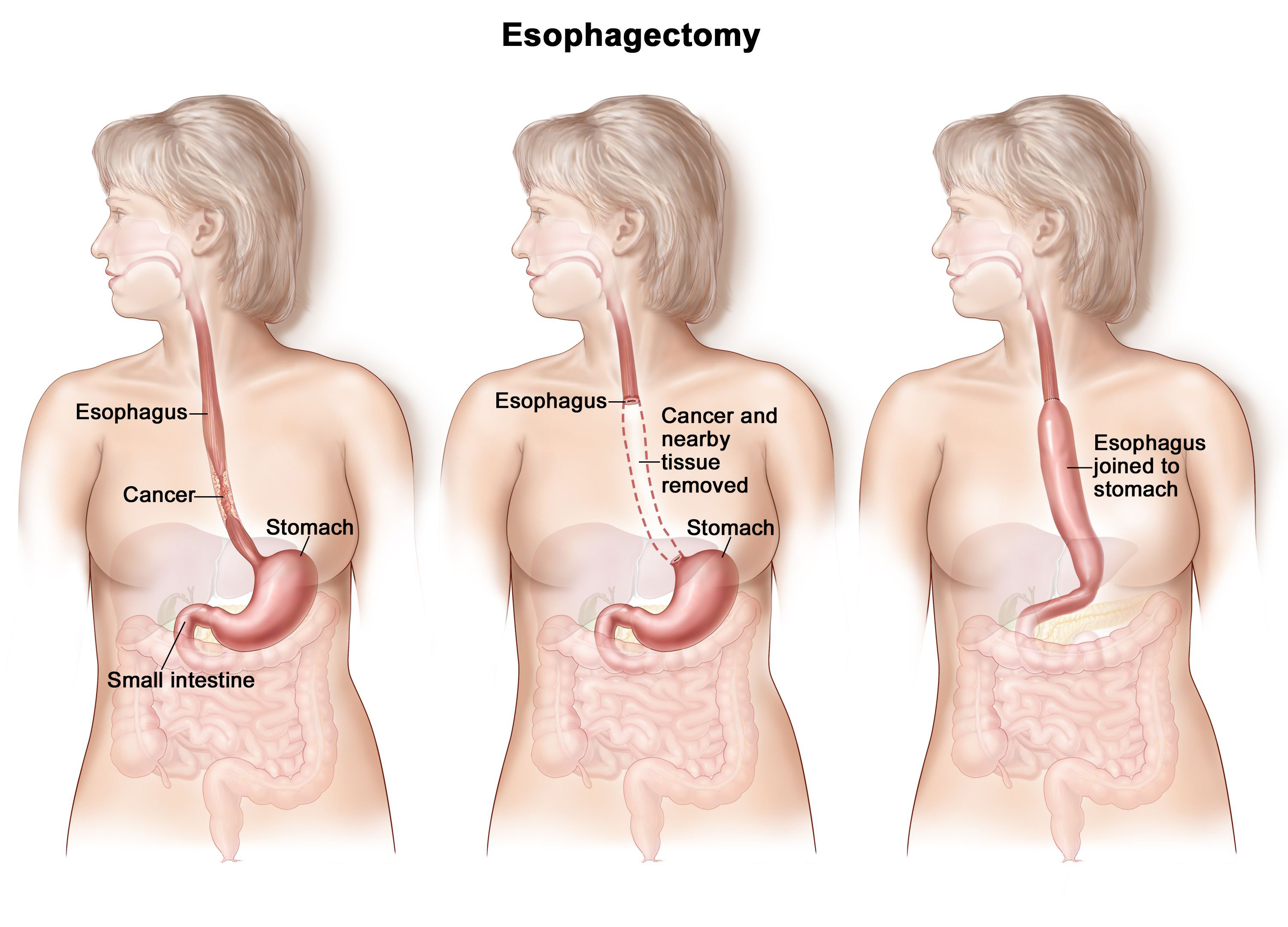
Esophagectomy
Surgery to remove some or most of the esophagus is called an esophagectomy. If the cancer has not yet
spread far beyond the esophagus, removing the esophagus (and nearby lymph nodes) may cure the cancer.
Unfortunately, most esophageal cancers are not found early enough for doctors to cure them with surgery.
Often a small part of the stomach is removed as well. The upper part of the esophagus is then connected
to the remaining part of the stomach. Part of the stomach is pulled up into the chest or neck to become
the new esophagus.
How much of the esophagus is removed depends upon the stage of the tumor and where it’s located:
- If the cancer is in the lower part of the esophagus (near the stomach) or at the place where the
esophagus and stomach meet (the gastroesophageal or GE junction), the surgeon will remove part of the
stomach, the part of the esophagus containing the cancer, and about 3 to 4 inches (about 7.6 to 10 cm)
of normal esophagus above this. Then the stomach is connected to what is left of the esophagus either
high in the chest or in the neck.
- If the tumor is in the upper or middle part of the esophagus, most of the esophagus will need to be
removed to be sure to get enough tissue above the cancer. The stomach will then be brought up and
connected to the esophagus in the neck. If for some reason the stomach can’t be pulled up to attach it
to the remaining part of the esophagus, the surgeon may use a piece of the intestine to bridge the gap
between the two. When a piece of intestine is used, it must be moved without damaging its blood
vessels. If the vessels are damaged, not enough blood will get to that piece of intestine, and the
tissue will die.
Esophagectomy techniques
Esophagectomy can be done in different ways. No matter which technique is used, esophagectomy is not a
simple operation, and it may require a long hospital stay. It is very important to have it done at a
center that has a lot of experience treating these cancers and performing these procedures.
Open esophagectomy: In the standard, open technique, the surgeon operates through one or more large
incisions (cuts) in the neck, chest, or abdomen (belly).
- If the main incisions are in the neck and abdomen, it is called a transhiatal esophagectomy.
- If the main incisions are in the chest and abdomen, it is called a transthoracic esophagectomy
- Some procedures might be done through incisions in all three places: the neck, chest, and abdomen.
You and your surgeon should discuss in detail the operation planned for you and what you can expect.
Possible risks of esophagectomy
Like most serious operations, surgery of the esophagus has some risks.
- Short-term risks include reactions to anesthesia, more bleeding than expected, blood clots in the
lungs or elsewhere, and infections. Most people will have at least some pain after the operation,
which can usually be helped with pain medicines.
- Lung complications are common. Pneumonia may develop, leading to a longer hospital stay, and
sometimes even death.
- Some people might have voice changes after the surgery.
- There may be a leak at the place where the stomach (or intestine) is connected to the esophagus,
which might require another operation to fix. This is not as common as it used to be because of
improvements in surgical techniques.
- Strictures (narrowing) can form where the esophagus is surgically connected to the stomach, which can
cause problems swallowing for some patients. To relieve this symptom, these strictures can be expanded
during an upper endoscopy procedure.
- After surgery, the stomach may empty too slowly because the nerves that cause it to contract can be
damaged by surgery. This can sometimes lead to frequent nausea and vomiting.
- After surgery, bile and stomach contents can back up into the esophagus because the ring-shaped
muscle that normally keeps them inside the stomach (the lower esophageal sphincter) is often removed
or changed by the surgery. This can cause symptoms such as heartburn. Sometimes antacids or motility
drugs can help these symptoms
How to protect yourselves ?
1) Avoid spices / smoked food
2) Avoid smoking
3) Daily exercise
4) Eat healthy food